


Are Lower-Cost Feeds a False Economy?
By Peter Van Wyk
Introduction
Since early 2022, a global oversupply of frozen shrimp and high inventory levels have placed extreme downward pressure on shrimp prices. The resulting decline in farmgate prices has cascaded through the supply chain, leading to historically low prices for postlarvae (PLs). In Latin American markets, PLs are now selling for as little as $2.00 per thousand, while prices in Asia are slightly higher.
As profit margins shrink, hatchery managers are under increasing pressure to reduce operating costs. However, in the short run, most major cost categories (management, labor, utilities, depreciation, and even the production of nauplii and algae) are largely fixed. Because broodstock must be maintained once stocked and overhead is tied to facility capacity, these costs cannot be reduced in the short run. In contrast, feed costs represent a true variable expense: the price and quality of formulated feeds can be adjusted from one cycle to the next. With few other options, many hatcheries have turned to lower-priced feeds to reduce expenses.
While this strategy appears rational, there are trade-offs when higher-quality, more expensive feeds are replaced with lower-priced, lower-quality feeds. Feed quality directly affects larval survival and growth. Larval survival, in turn, determines hatchery revenues by changing the number of PLs available to sell. It also affects the average fixed cost per PL—when fewer PLs survive, total fixed costs are divided among fewer animals, raising the cost per PL produced. Thus, the overall economic impact of switching to cheaper feeds depends on the balance between the direct savings from lower feed prices and the combined effects of reduced survival on both revenues and fixed costs per PL.
The objective of this article is to analyze the relative sensitivity of hatchery profits to changes in feed price and survival as a function of PL sales price.
Modeling Approach and Assumptions
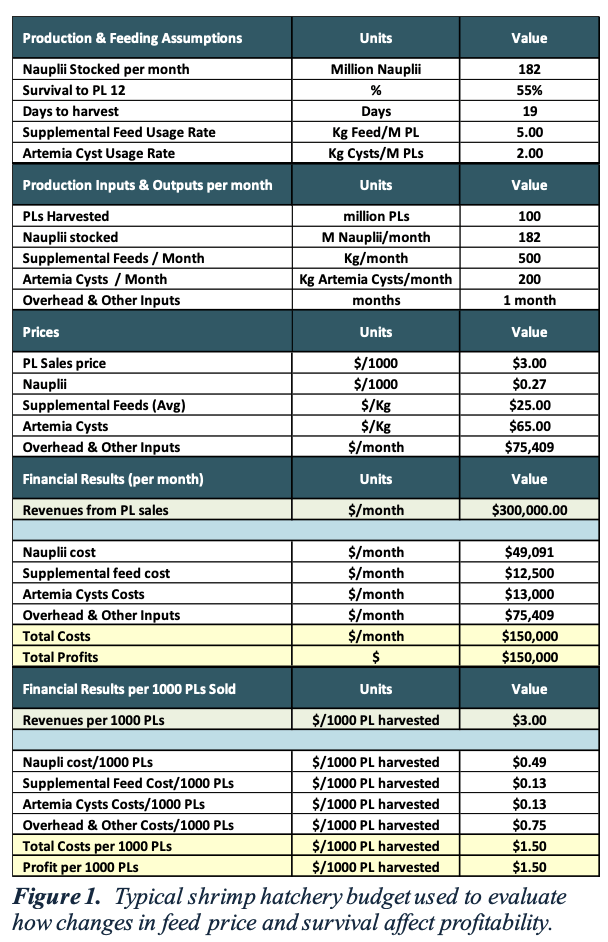
To evaluate these relationships, a typical shrimp hatchery budget (Figure 1) was used to model the effects of changes in average supplemental feed price and survival on hatchery profitability. The hatchery budget was based on a typical operation producing 100 million PLs per month. Costs for nauplii, Artemia, and supplemental feed were based on typical industry values. All remaining expenses were grouped as Overhead & Other Costs and estimated by assuming a total production cost of $1.50 per thousand PLs, typical for large hatcheries. Overhead was calculated as total production cost minus the sum of nauplii, Artemia, and supplemental feed costs. All costs are expressed in U.S. dollars per 1,000 PLs.
Sensitivity Analyses
Profit sensitivity to feed price and survival was examined through a series of sensitivity analyses. Profits were recalculated after changing each variable in 1% increments while keeping all other parameters constant. Additional analyses were conducted at two PL sales prices ($3.00 and $2.00 per 1,000 PLs) to show how PL price influences sensitivity to feed price and survival. The baseline scenario assumed a monthly stocking of 182 million nauplii, 55% survival, and an average supplemental feed price of $25 per kg.
For the feed-price sensitivity analysis, profits were recalculated after reducing feed price in 1% increments while holding all other variables constant. For the survival sensitivity analysis, profits were recalculated after increasing survival in 1% increments, again keeping all other values fixed. Both analyses were performed at PL prices of $3.00 and $2.00 per thousand PLs to quantify how PL market price affects the sensitivity of profitability to feed price and survival.
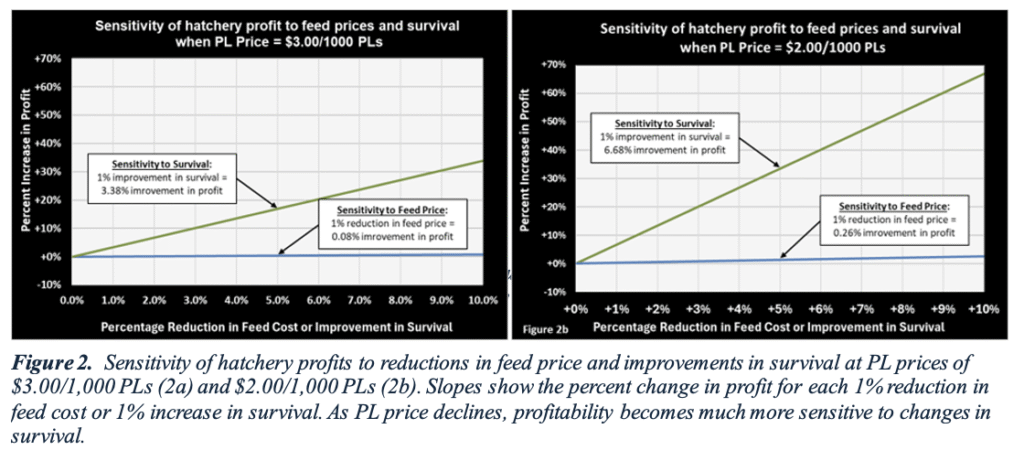
Results of the sensitivity analyses are shown in Figure 2. Each graph presents the relationship between hatchery profits and changes in a single variable (feed price or survival) at two PL sales prices ($3.00 and $2.00 per 1,000 PLs). For each analysis, profits were recalculated after changing the selected variable in 1% increments while holding all other parameters constant. These slopes show how profits respond to changes in feed price or survival under different market conditions.
The results clearly show that profits are far more sensitive to changes in survival than to changes in feed price. At a PL price of $3.00 per 1,000 PLs (Figure 2a), a 1% reduction in feed price increases profit by only 0.08%, while a 1% improvement in survival increases profit by 3.38%. When PL price declines to $2.00 per 1,000 PLs (Figure 2b), a 1% reduction in feed price increases profit by 0.26%, whereas a 1% improvement in survival increases profit by 6.68%. The steeper slopes at the lower PL price reflect shrinking margins, where a given change in cost or revenue produces a proportionally larger change in profit.
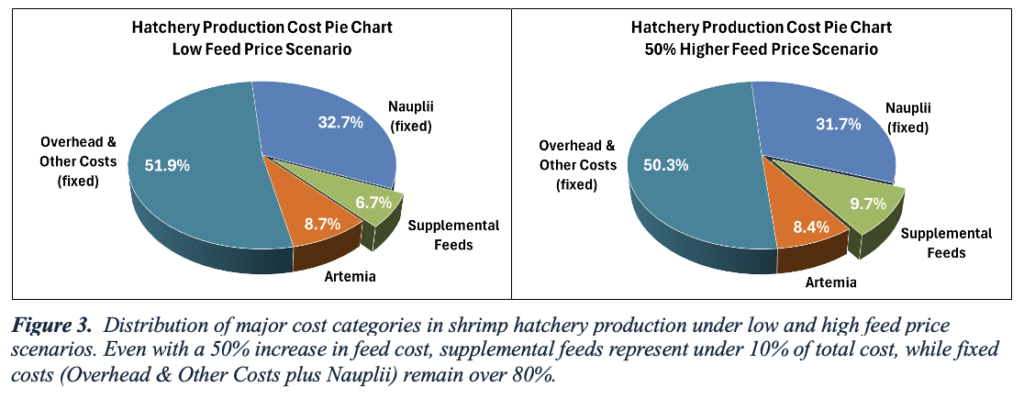
An examination of typical hatchery cost structure (Figure 3) helps explain why feed price has only a modest effect on profitability. Under the low-feed-price scenario, Fixed Costs (Overhead & Other Costs plus Nauplii) account for just over 80% of Total Cost, while Supplemental Feed Cost represents only about 6.7%. A 50% increase in feed price has little effect on hatchery cost structure. Fixed Costs still exceed 80% of Total Cost, and Supplemental Feed Cost remains under 10%. In this example, a 50% increase in Supplemental Feed Cost increases Total Cost by only 3.3%. Because feed makes up such a small share of Total Cost, even large price changes have minimal impact on profitability.
Survival, on the other hand, affects both sides of the profit equation. Revenues are directly proportional to the number of PLs harvested, so a 1% increase in survival produces a 1% increase in revenue. But the effect extends beyond revenue. Because most costs for Nauplii, Artemia, and Overhead & Other Costs are fixed within a production cycle, higher survival spreads those costs over more PLs, lowering the fixed cost per PL produced. The combined effect of increased revenue and reduced unit cost amplifies the profit response to changes in survival, as shown by the steeper slopes in the survival sensitivity graph in Figure 2.
Taken together, these results demonstrate why reductions in feed price yield only small gains in profit, whereas improvements in survival produce large increases. Feed price influences only a small component of Total Cost, whereas survival simultaneously increases revenue and decreases unit cost by diluting fixed expenses. The analysis also highlights the vulnerability of hatchery profitability to survival losses under low market prices: as margins tighten, small changes in survival have disproportionately large economic impacts.
It should also be noted that the feed-price analysis assumes survival remains constant when feed prices change (an assumption seldom true in practice). Lower-priced feeds often achieve their price advantage by compromising ingredient quality, nutrient stability, or digestibility, all of which can reduce larval performance. Consequently, the actual profit response to feed-price reductions is likely smaller than the theoretical estimates presented here.
How Feed Quality Influences Survival
While it is clear hatchery profits are far more sensitive to survival than to feed price, the key question is how feed price relates to survival. Higher-quality supplemental feeds support higher survival because they provide balanced and highly digestible nutrition that promotes fast, healthy development. Premium marine ingredients such as refined fish meals, krill meal, squid meal, and fish protein hydrolysates provide easily absorbed proteins, balanced amino acids, and essential fatty acids. These nutrients are important for early growth, organ development, and immune function. Natural attractants help larvae begin feeding quickly and consistently, which improves digestion and growth. As a result, larvae grow into larger and stronger postlarvae that tolerate stress better and are less likely to get sick. This leads to higher survival in the hatchery, as well as better performance later in nursery and grow-out, where most profits are made.
Survival is further enhanced when diets provide the nutrients larvae need without large excesses. Highly digestible ingredients improve nutrient assimilation, reducing waste and helping to control ammonia, a common chronic stressor in larval systems. Low ammonia and stable water quality strengthen health and reduce background mortality. In contrast, many lower-quality diets are over-formulated to compensate for ingredients with inferior nutrient profiles. Over-formulated diets generate excess wastes that degrade water quality, slow growth, and increase mortality risk. Excess wastes may also increase water-treatment requirements, adding to operating costs.
In short, high-quality diets give larvae the balanced nutrition, healthy water conditions, and stronger disease resistance needed to survive at higher rates in the hatchery and beyond, making feed quality a key driver of long-term hatchery success.
Breakeven Survival
While most hatchery managers agree that higher-quality feeds can improve survival, switching to a more expensive diet involves risk. If survival does not increase enough to offset the higher feed cost, the operation can lose money. This concern is especially important when PL prices are low, because a larger improvement in survival may be needed to cover the added cost. The key question then becomes: How much must survival improve to justify the use of a higher-priced feed?
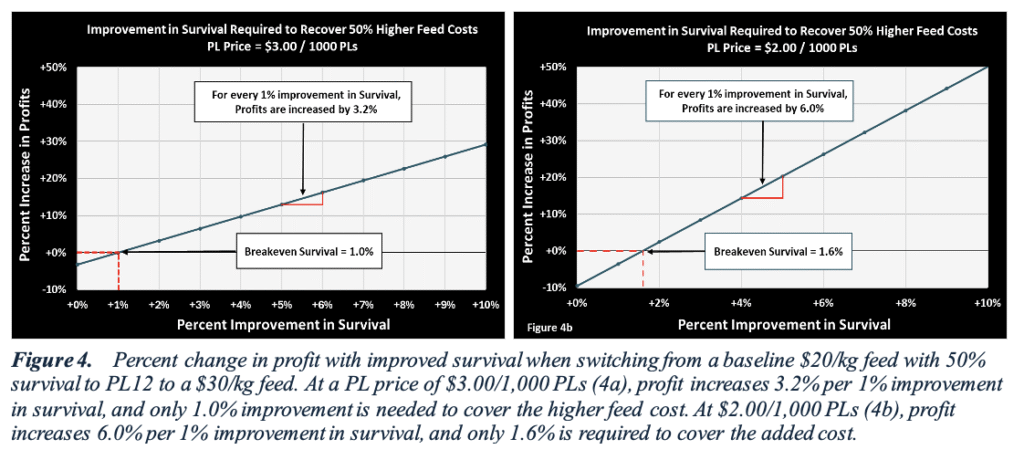
A simple example helps illustrate the concept. Consider a hatchery using a lower-priced diet with an average feed cost of $20 per kg and considering switching to a higher-quality diet averaging $30 per kg. At a PL price of $3.00 per 1,000 PLs, survival would need to improve by only about 1.0% to cover the higher feed cost (Figure 4a), and each 1% improvement in survival increases profit by roughly 3.2%. If PL price falls to $2.00 per 1,000 PLs, the breakeven improvement rises slightly to about 1.6% (Figure 4b), with profits increasing about 6.0% per 1% improvement in survival. Because of the high sensitivity of profits to changes in survival, even substantial differences in feed price can be overcome with modest and realistic survival gains.
Conclusion
The greatest economic gains come from improving survival because each additional PL produced directly increases revenue. Higher survival also spreads fixed costs over more animals, raising profit per unit. In contrast, lowering feed costs only reduces a small portion of total production cost, so even large reductions in feed price produce relatively small gains. As a result, only modest improvements in survival are needed to offset even large increases in feed cost.
High quality feeds help achieve these gains by supporting healthy, fast-growing larvae with better stress and disease resistance, leading to higher survival throughout production. For this reason, the best strategy for improving profitability is to invest in feeds that maximize survival. This is especially important when PL prices are low and margins are tight, because this is when profits are most sensitive to survival.

Peter Van Wyk is Global Technical Sales Manager for Zeigler Bros. Inc.
E-mail address: peter.vanwyk @ zeiglerfeeds.com
AQUA Culture Asia Pacific