


When evaluating larval feeds, it is easy to assume that more protein means better performance. Under pressure to control production costs, hatcheries may be particularly attracted to lower-cost feeds with high crude protein levels, believing they offer more nutritional value for the money. But protein percentage and cost per unit of protein tell only part of the story.
What matters is how efficiently that protein is used. Protein efficiency measures the grams of shrimp biomass produced per gram of protein fed. A well-formulated feed that meets the shrimp’s amino acid requirements with less total protein can have greater protein efficiency than a feed containing more crude protein. This was one of the important lessons learned during the development of Z Pro at the Zeigler Aquaculture Research Center (ZARC).
Lower-cost, high-protein feeds can have costs that may not appear on the feed price tag. Protein supplied in excess of the shrimp’s nutritional requirements contributes additional nitrogen to the culture system, increasing the potential for ammonia and bacterial loading. The result can be poorer water quality and reduced larval performance.
More Protein Does Not Necessarily Mean Better Performance
Faster-growing shrimp require more nutrition to support their increased growth potential. Over the past 15 to 20 years, improved genetics have increased the growth rates and harvest weights of post-larval shrimp, increasing the nutritional demands placed on hatchery feeds. But meeting those increased nutritional requirements does not simply mean increasing the crude protein level of the feed.
Protein is valuable because it supplies the amino acids needed for growth. Different protein sources, however, contain different levels and proportions of essential amino acids. By selecting high-quality protein sources with higher levels of key limiting amino acids, such as lysine and methionine, it is often possible to meet the amino acid requirements of shrimp with a lower total protein level.
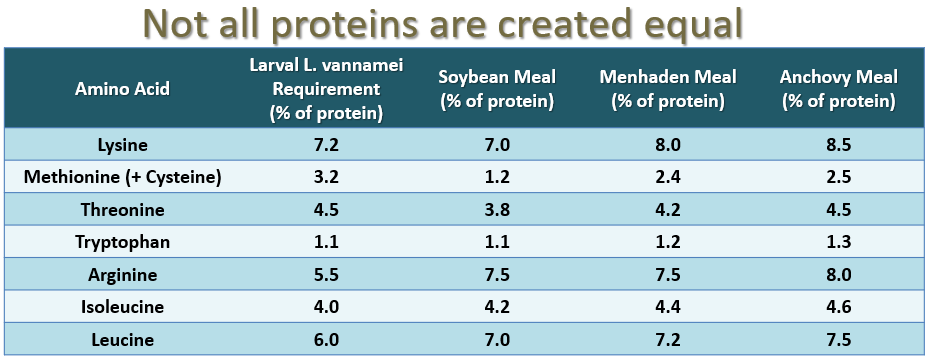
Digestibility is also important. Protein can only contribute to growth if it can be digested and its amino acids absorbed and utilized by the shrimp. During the development of Z Pro, researchers at ZARC focused on matching the nutritional profile of the feed to the requirements of the shrimp and selecting high-quality, highly digestible ingredients.
The objective is not to maximize the amount of protein in the feed. It is to meet the nutritional requirements of the shrimp as efficiently as possible while minimizing waste from nutrients supplied in excess of those requirements.
The Hidden Cost of Excess Protein
Protein that is not retained as shrimp biomass contributes nitrogen to the culture system. Some of that nitrogen can ultimately contribute to ammonia accumulation and increased bacterial loading. In an intensive larval-rearing system, both can negatively affect water quality and shrimp performance.
Research conducted at ZARC demonstrated that ammonia concentrations as low as 1 mg/L negatively affected PL harvest weight. This makes protein efficiency more than simply a feed formulation issue. Efficient use of dietary protein can also have important consequences for the culture environment in which the larvae must grow.
ZARC research also demonstrated why crude protein percentage alone can be misleading when evaluating a larval feed. In trials comparing diets with different protein levels, increasing dietary protein did not result in greater PL harvest weight. Instead, the higher-protein diets produced more ammonia, while Z Pro supported strong growth at a lower dietary protein level.
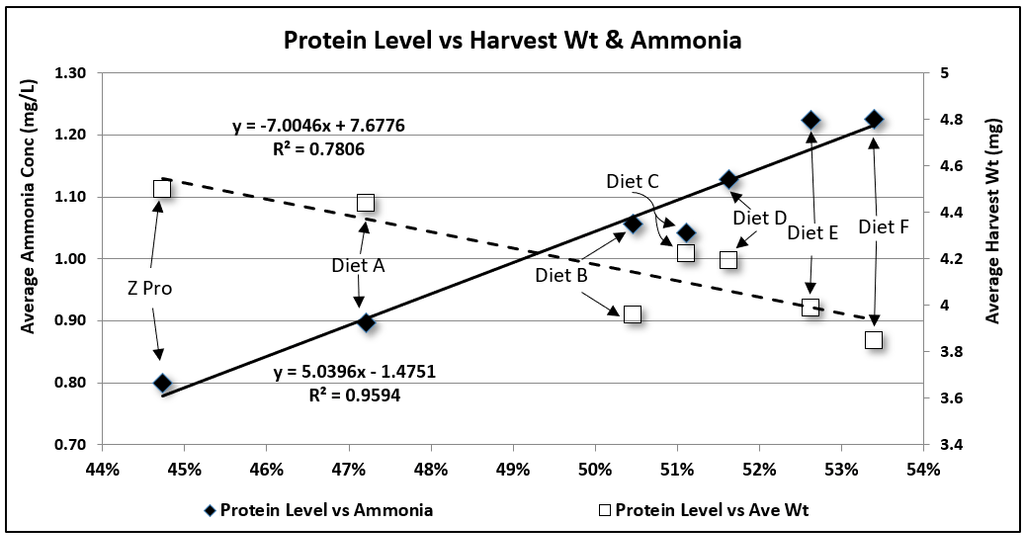
These results illustrate an important point: additional protein has little value if it does not result in additional shrimp biomass. Instead, excess protein can increase nitrogen waste and contribute to deterioration of the culture environment.
Protein Efficiency Creates Value
The true value of a larval feed cannot be determined simply by comparing its price per kilogram or even its cost per unit of crude protein. The biological performance produced by that feed also needs to be considered.
This is particularly important when considering survival. Improved protein efficiency can reduce nitrogen waste, helping to reduce ammonia and bacterial loading in the culture water. If improved water quality results in even a small improvement in survival, the additional revenue from selling more PL can more than offset the higher cost of a premium feed.
The economics can be significant. A hatchery economic calculator developed by Zeigler using globally collected data indicated that a 5% improvement in survival could increase hatchery profits by as much as 17%. In a commercial hatchery trial, the Zeigler diet cost more than 50% more than the competitor feed cocktail, yet profit per tank was 9% higher.
The benefits of good larval nutrition may also extend beyond the hatchery. In a commercial evaluation in Mexico, PL produced using Z Pro as the primary dry feed subsequently had significantly higher survival in raceways than PL produced using the hatchery’s standard cocktail of competitor dry feeds.
A Better Way to Measure Feed Value
As shrimp genetics continue to improve, hatchery nutrition must evolve to support their increased growth potential. Simply adding more protein is not necessarily the answer.
Protein efficiency provides a better way to think about protein in larval feeds. The objective is to supply highly digestible protein with an amino acid profile that closely matches the nutritional requirements of the shrimp. By meeting those requirements efficiently, the feed can maximize the nutritional benefits of dietary protein while minimizing nitrogen waste and its negative impacts on water quality and microbial loads.
For hatchery managers, this changes the question they should ask when comparing feeds. Rather than asking, “Which feed gives me the most protein for my money?”, the more important question is:
“How efficiently is the protein I am feeding converted into shrimp biomass?”
That is the difference between measuring the cost of a feed and understanding its value.